Redefining Revenue Management for Rail & Bus: Integrated, Real-time and AI-assisted
As rail & bus operators face an increasingly competitive market, revenue management is no longer a nice-to-have - it is a core tool to optimise revenue, effectively match supply and demand, and guarantee that occupancy is as efficient as possible. It is the difference between a full train and one running half-empty.
Yet, most revenue management systems running today were never built for rail & bus. They were borrowed from airlines: operators adopted revenue management in the early 90s, following the airlines that had pioneered it two decades earlier - and most systems still carry that inherited logic. But a train or a bus is not a plane, and that mismatch is what’s costing operators revenue.
The operational gaps in traditional revenue management
The typical RM systems found today in rail & bus operators have several limitations. This is mostly because these are legacy systems, built on revenue management approaches for air travel, since that’s what was available at the time. A lot of these systems are still in place, but they have clear shortcomings:
Based on airline logic
The reality of ground passenger transport is more complex than simply going from A to B. Rail & bus have multiple origin-destination pairs (because of all the stops within a route) which need to be treated independently for revenue management optimisation.Updates in batch
Revenue management systems need to interact with the IMS (Inventory Management System) - very often, this is usually a batched update that happens once a day. The RM is always behind, instead of working with actual, real-time data.Hard to build forecasts
Forecasts need to be built from scratch, using custom logic and requiring high maintenance, eventually leading to them being dismissed or not used at all.Isolated from the rest of the system
Typical RM systems for rail & bus run as standalone tools - they connect to the IMS through a batch feed instead of being natively integrated. Thus, the data the RM works with is thin (little more than origin-destination, train number and class of service) and with no direct access to the full commercial picture. The analysts can’t get specialised, real-time dashboards, having limited visibility into what is actually driving performance.
These limitations lead to a gap between what the system sees and what's happening in reality - resulting in lost revenue. Rail & bus operators need a better system: one that challenges these norms and is built for their operational and commercial reality.
Redefining the norm in revenue management for rail & bus
The revenue management solution developed by Sqills addresses these limitations, since it’s built natively in S3 Passenger - where reservations, tickets, timetables, inventory, fares and customer data already live. Thus, there's no integration layer to maintain, and no need for data syncing between systems.
This approach allows revenue management to be connected in real time with other modules like Navigator, Fare, Pricing Engine, Inventory and Ticket. So, more than a data feed model, what we have is real-time integration, where the RM is positioned at the heart of a full-fledged PSS (Passenger Service System).
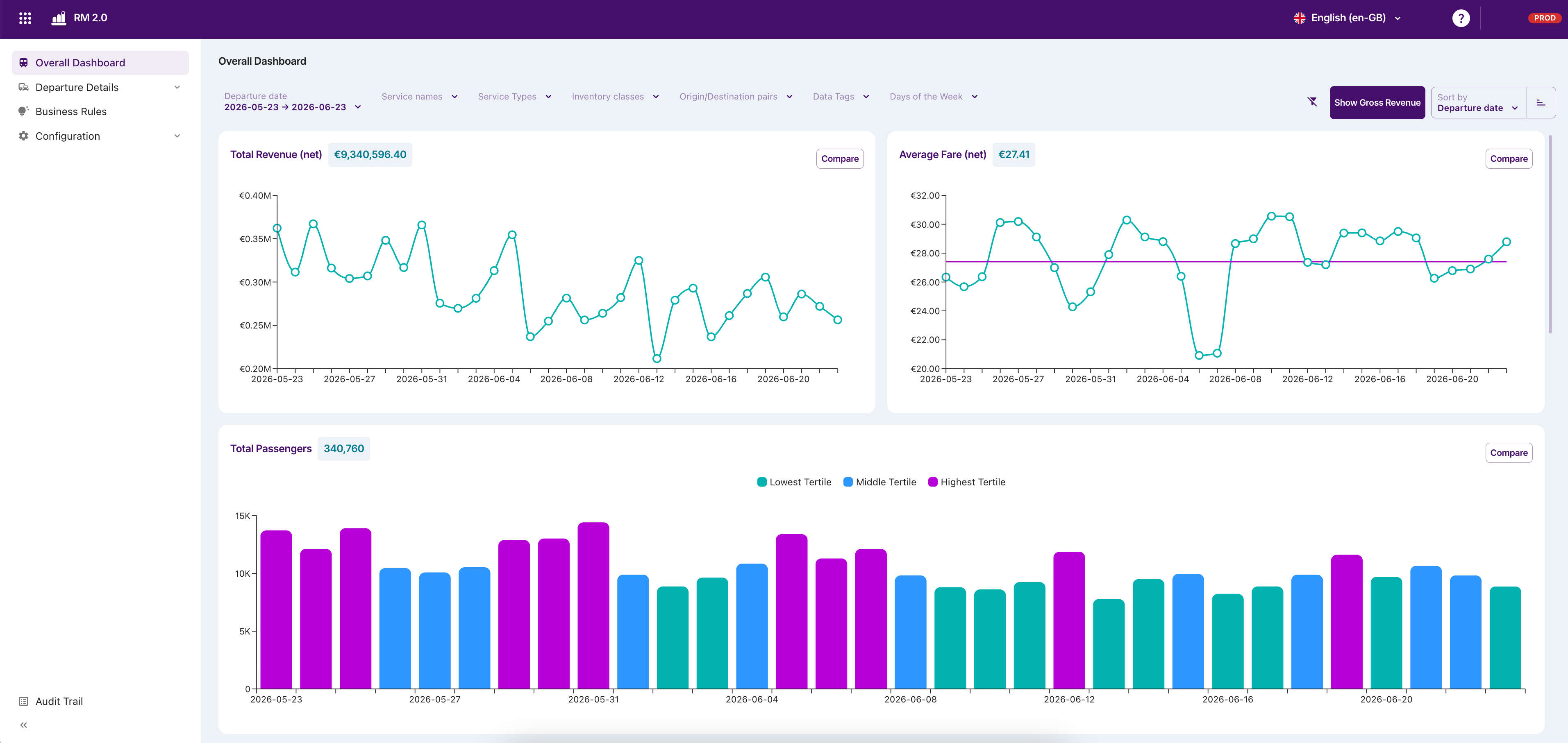 Besides this, the RM developed by Sqills also overcomes the legacy logic inherent to many systems currently in place. Since it was built from scratch for rail & bus, it specialises in optimising not only the whole route, but all the possible independent origin-destination pairs.
Forecasting is also immensely improved in relation to typical legacy systems. Not only because of the real-time access to important commercial and operational data, but also because the system uses machine learning models and a retraining approach to accurately predict future demand.
In fact, accurate forecasting and price recommendations are very hard to achieve in rail & bus, due to the “booking limit dilemma” and the “curse of dimensionality”, two concepts that are important to understand.
Overcoming the booking limit dilemma & the curse of dimensionality
Rail & bus operators sell tickets at different price points, organised into what we can call "buckets”: a train or intercity bus might have multiple “buckets”, at €10, €30, €70, etc. Analysts need to figure out how many seats to allocate to each of these buckets, thus establishing the “booking limit” for each bucket.
The core of the “dilemma” is how many seats to assign to the different buckets: too many seats in the €10 bucket fill the train fast, but miss potential revenue; too many in the €70 bucket generate more revenue per seat but risk running a semi-empty train. This can become incredibly complex, as seats need to be allocated to different buckets, in different trains, for all the possible origin-destination pairs.
As an example, let’s think of one route from A to B with no intermediate stops, 15 price buckets and 500 seats. Even assuming booking limits only increase from one bucket to the next, that single route already has 18 octillion different possible seat allocations.
And that is the conservative version - a real route with multiple stops will sell many origin-destination pairs at once, and each one multiplies the problem. Across 40 OD pairs (common on intercity networks), the combinations run to more than 1,100 digits.
This is what we call the “curse of dimensionality”: how rapidly the number of possible seat allocation combinations grows, as the number of pricing buckets and origin-destination pairs increases.
Traditional systems struggle with this much data, because they will look into every possible combination before suggesting the best allocation. The revenue management system developed by Sqills proposes a different approach, leveraging AI and Machine Learning.
AI and machine learning based revenue management
One of the main advantages of the RM system from Sqills is how it uses AI and Machine Learning to help RM analysts overcome the booking limit dilemma. Instead of treating every single combination individually, the system uses AI models to "generalise" and learn the underlying features of the allocations, making the process a lot more manageable. This way, the system learns about the core problem, instead of evaluating every possible answer.
Rather than relying on a single fixed calculation, the system improves by proposing an allocation, checking how it is likely to play out, and adjusting based on the result. For a given train or bus departure, it proposes the ideal distribution of seats across pricing buckets, assesses how that allocation would likely perform against expected demand, and feeds the outcome back in. Across many of these cycles, it learns which allocations tend to work in which situations, rather than memorising an answer for every possible scenario.
This is exactly what lets the system break the "curse of dimensionality": it finds strong booking limits without testing every combination, and without the infinite computing power that this would otherwise require.
Improving the learning process: human in the loop
The system learns from the human analyst as well, which is fundamental for its improvement. Instead of simply deploying the calculated booking limits, the AI recommends them. So the human always has the final say. The system tracks how the human analyst responds to its recommendations: which ones (and for which departures) were actually applied in production, and which ones were changed or modified (and by how much).
This feedback loop between the AI and the human analyst is vital and dramatically improves the system’s efficiency, since evaluating the AI’s decisions only in a simulated environment is not ideal.
Conclusion
For rail & bus operators, revenue management is today a core tool and a fundamental asset for their operations, which is why having the right system for the job becomes a competitive advantage. Legacy RM systems, based on airline logic, updating once a day, and living independently from other systems like the IMS and the PSS, can no longer serve operators well.
Fortunately, revenue management for rail & bus is finally catching up. Operators can now benefit from a solution that is perfectly suited to their commercial and operational needs - integrated with other data sources, providing real-time insights that ultimately lead to accurate forecasts of future demand.
To achieve this, Sqills relied on new technological developments (such as AI and machine learning) but, more importantly, on 20 years of experience working with more than 50 rail & bus operators worldwide. The result is an RM solution built specifically for them, and developed with them.

